
Surcharging vs. Cash Discount Program: Merchant Compliance and Implementation Guide
Credit card processing fees represent one of the fastest-growing operational expenses for modern merchants. Between interchange rates, assessment fees, and processor markups, businesses routinely surrender 2% to 4% of every swipe. To protect margins, retailers, restaurateurs, and service providers increasingly explore passing these costs along to cardholders.
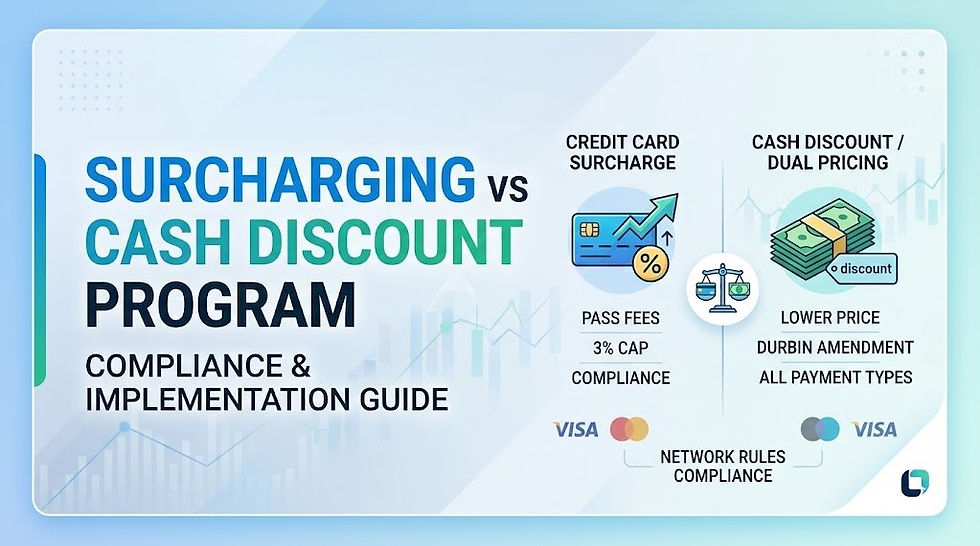
When structuring a fee-offset strategy, businesses generally evaluate two models: a credit card surcharge or a cash discount program (frequently executed as dual pricing). While both approaches aim to recover interchange expenses, their legal structures, operational workflows, and card brand compliance requirements differ substantially.
Understanding the mechanics of surcharging vs cash discount programs is essential to avoiding severe processor fines, legal penalties, and customer churn.
1. Credit Card Surcharge, Convenience Fee, and True Cash Discount: Legal Differences
Many merchants mistakenly treat these three terms as interchangeable. In the eyes of payment networks and federal regulatory frameworks, they represent distinct billing mechanisms governed by separate compliance standards.
+----------------------------------------------------------------------------------------------------+
|                                     FEE STRUCTURE COMPARISON                                       |
+---------------------+-------------------------------+--------------------+-------------------------+
| Program Type        | Customer Perception           | Eligible Payment   | Network Notification    |
+---------------------+-------------------------------+--------------------+-------------------------+
| Surcharge           | Added fee at checkout         | Credit Cards ONLY  | Mandatory (30-day notice|
| Convenience Fee     | Added fee for convenience     | Fixed/Flat fee     | Permitted on specific   |
|                     | channel (e.g., web/phone)     | across all cards   | non-standard channels   |
| Cash Discount /     | Displayed price discounted    | Cash, Check, Debit | Not required            |
| Dual Pricing        | for cash / base card price    | (in true programs) |                         |
+---------------------+-------------------------------+--------------------+-------------------------+
True Cash Discount & Dual Pricing
Under the Dodd-Frank Wall Street Reform and Consumer Protection Act (Durbin Amendment), merchants retain the federal right to offer discounts to incentivize customers to pay by cash, check, or debit card.
In a true cash discount, the listed regular shelf or menu price is the card price, and customers receive an explicit reduction when paying with paper tender.
Dual pricing formalizes this model by displaying both the card price and cash price side by side on menus, digital boards, shelf tags, and terminal screens. Dual pricing eliminates unexpected fees at the register because the customer sees both transaction totals upfront.
Credit Card Surcharge
A credit card surcharge is an additional percentage fee added to the standard transaction total when a customer pays with a credit card.
Credit Only: Surcharging can never be applied to debit cards, prepaid cards, or electronic benefit cards (EBT), even if a debit card is processed "as credit" without a PIN (signature debit).
Network rules treat applying a fee to any debit card as a critical violation subject to immediate financial penalties.
Convenience Fee
A convenience fee is a flat or fixed charge assessed for the privilege of paying through an alternative, non-standard payment channel outside the merchant’s customary business practice.
Channel Specificity: A brick-and-mortar utility company or university that takes in-person payments can apply a convenience fee to online or phone credit card transactions.
Fixed vs. Percentage: Unlike a percentage-based surcharge, convenience fees are typically flat rates and must be disclosed prior to payment completion. They cannot be assessed simply because a card is tapped in-store.
2. State-by-State Legal Status and Card Network Compliance Caps
Implementing a surcharge requires cross-referencing state laws with strict major credit card network rules.
Visa Surcharging Rules Compliance
Visa updated its surcharge rules under its Core Rules and Product/Service guidelines to cap merchant surcharges:
The 3% Maximum Cap: Visa limits credit card surcharges to the merchant’s actual Cost of Acceptance (COA) or a maximum ceiling of 3.0%, whichever is lower. (While Mastercard previously permitted up to 4.0%, Visa's 3.0% cap creates a practical ceiling of 3.0% for any merchant accepting Visa).
Acquirer Notification: Merchants must notify their payment processor/acquirer in writing at least 30 days prior to launching a surcharge program.
Level Playing Field: A merchant cannot surcharge Visa credit cards unless they apply identical terms to competing card brands with equal or higher processing costs (e.g., American Express, Mastercard, Discover).
Penalties: Failure to comply with Visa surcharging guidelines triggers an escalating schedule of non-compliance fines, beginning at $1,000 for an initial violation and compounding up to $150,000+ for prolonged non-compliance.
Credit Card Surcharge Legal States
The legal landscape for surcharges continues to evolve due to constitutional challenges centered on commercial free speech:
Jurisdiction Category | States / Regions | Legal Framework & Requirements |
Strictly Prohibited | Connecticut, Massachusetts, Maine, Puerto Rico | Outright statutory bans prohibit credit card surcharging at the register. Merchants operating here must use true cash discounts, dual pricing, or standard all-in pricing. |
Capped Lower Than Network Rules | Colorado, Oklahoma | State statutes cap surcharges below network rules: Colorado limits surcharges to 2% or actual cost; Oklahoma caps credit card surcharges at 2% or actual cost. |
Mandatory Total Price Posting | New York | Under New York General Business Law § 518, businesses cannot post a single cash price and tack on a surcharge at checkout. Businesses must clearly display the total credit card price (inclusive of the surcharge) anywhere prices are displayed. Dual pricing is the gold standard in NY. |
Actual Cost Limits | New Jersey, Nevada, South Dakota | Surcharges cannot exceed the merchant’s actual processing cost; excessive markup violates state consumer protection laws. |
Permitted (Network Rules Apply) | Most Other States (Texas, California, Florida, etc.) | Permitted, provided the merchant complies with the federal 0% debit rule, the 3% cap, and signage disclosure rules. |
3. Customer Signage and Receipt Line-Item Disclosure Rules
To prevent consumer deception and unfair trade practices, payment networks and federal authorities enforce strict disclosure standards.
1. Point of Entry (Entrance Signage)
A customer must know before walking in that a card fee applies. A sign placed at every customer entrance must state:
That a credit card surcharge is assessed on credit transactions.
The exact surcharge percentage applied (e.g., 2.5% or 3.0%).
A clear disclaimer noting that the surcharge does not apply to debit or prepaid cards.
2. Point of Sale / Counter Signage
Prominent notices must be posted at every physical register, service desk, or online checkout page.
Compliant Counter Disclosure Example: "We apply a 3.0% surcharge on all credit card transactions, which reflects our cost of card acceptance. We do not surcharge cash, check, or debit cards. You may pay with cash or debit to avoid this fee."
For eCommerce merchants, the surcharge warning must appear on the payment selection page, before the consumer clicks "Submit Payment".
3. Transaction Receipts and Line-Item Transparency
Hiding a surcharge within a "service fee" or inflating product prices without separate accounting is non-compliant. Receipts must show:
Subtotal of goods/services.
Exact dollar value of the surcharge, displayed as a separate line item labeled "Credit Card Surcharge" (or similar explicit wording).
Sales tax calculated appropriately according to municipal and state tax rules.
Final charged total.
4. Hardware and Point-of-Sale Configurations for Automated Dual Pricing
Implementing these programs manually is prone to human error. Cashiers regularly forget to ask whether a card is debit or credit, risking debit surcharging violations. The modern solution is deploying a dual pricing payment terminal and automated POS logic.
                          PAYMENT FLOW ARCHITECTURE

                           [ Customer Inserts Card ]
                                       |
                                       v
                     [ Terminal Performs BIN Lookup ]
                                       |
                  +--------------------+--------------------+
                  |                                         |
          (BIN Identifies DEBIT)                   (BIN Identifies CREDIT)
                  |                                         |
                  v                                         v
         Processes Base Price                     Applies Surcharge /
         (No Surcharge Added)                      Card Price (Max 3%)
                  |                                         |
                  +--------------------+--------------------+
                                       |
                                       v
                     [ Prints Itemized Receipt w/ Line Item ]
Bank Identification Number (BIN) Routing
Compliant smart terminals use real-time BIN range detection. When a customer inserts, swipes, or taps their card:
The terminal instantly reads the first 6 to 8 digits (the BIN/IIN).
The software determines whether the card is drawn against a credit line or a bank depository account (debit/prepaid).
If the card is a Debit Card, the system suppresses the surcharge fee automatically preventing statutory violations even if the cardholder chooses "Run as Credit."
If the card is a Credit Card, the terminal dynamically calculates the permissible surcharge, prompts the customer to accept the total, and prints the itemized receipt.
Automated Customer-Facing Screens
Rather than forcing staff to explain pricing policies, dual-pricing payment devices present both paths directly to the customer on a dynamic screen:
Button 1: Pay Cash: $100.00
Button 2: Pay with Card: $103.00
This approach meets strict state mandates such as New York’s total-price display rule while eliminating friction at the register.
5. Strategic Comparison: Which Program Fits Your Business?
Choosing between surcharging and cash discounting/dual pricing depends on your geographic location, customer demographic, and point-of-sale capabilities.
+----------------------------------------------------------------------------------------------------+
|                                    DECISION MATRIX FOR MERCHANTS                                    |
+------------------------------------+--------------------------------+------------------------------+
| Factor                             | Credit Card Surcharging        | Cash Discount / Dual Pricing |
+------------------------------------+--------------------------------+------------------------------+
| 50-State Legality                  | No (Banned in CT, MA, ME, PR)  | Yes (Universal across 50     |
|                                    |                                | states under Durbin Amend.)  |
| Debit Card Application             | Strictly Prohibited            | Allowed (Base price applied) |
| Processor Surcharge Registration   | 30-day advance notice to Visa  | None required                |
| Maximum Processing Cost Recovery   | Capped at 3.0% (or state cap)  | Full fee recovery            |
| Operational Complexity             | High (BIN validation, audits)  | Low (Hardware-driven display)|
| Customer Perception                | Negative (Viewed as a penalty) | Positive/Neutral (Discount)  |
+------------------------------------+--------------------------------+------------------------------+
When to Choose Surcharging:
You operate in B2B or wholesale environments where credit card processing fees are standard line-item costs.
Your operations are located in jurisdictions that permit direct surcharges.
Your transactions are primarily online, and your shopping cart integrates compliant BIN-detection engines.
When to Choose Cash Discounting / Dual Pricing:
You operate a high-volume retail shop, quick-service restaurant, or brick-and-mortar storefront.
You operate across multiple states, including jurisdictions with strict surcharge prohibitions (like Connecticut or Massachusetts).
You want a compliant, out-of-the-box system that insulates your business from card network audit penalties.
Protect Your Margins with Compliant Payment Processing
Navigating card network caps, statutory mandates, and point-of-sale upgrades does not have to be complicated. Whether you deploy an itemized credit card surcharge or upgrade to an automated dual-pricing payment terminal, zero-cost processing can save your business thousands of dollars each month while keeping you in full compliance with Visa and state regulations.
Ready to eliminate credit card processing fees without violating card network rules?
Contact our payment specialists today for a free merchant statement audit and discover the right compliant terminal configuration for your business. Click Here


Comments