
High-Risk Merchant Account vs. Standard: The Definitive Guide to Payment Processing Stability
Securing the ability to accept credit card payments is one of the most critical operational milestones for any modern business. However, thousands of business owners discover each week that not all payment processing accounts are created equal. Many find their applications unexpectedly rejected, their processing rates inflated far beyond initial quotes, or worse their accounts suddenly frozen and funds held indefinitely by flat-rate aggregators.
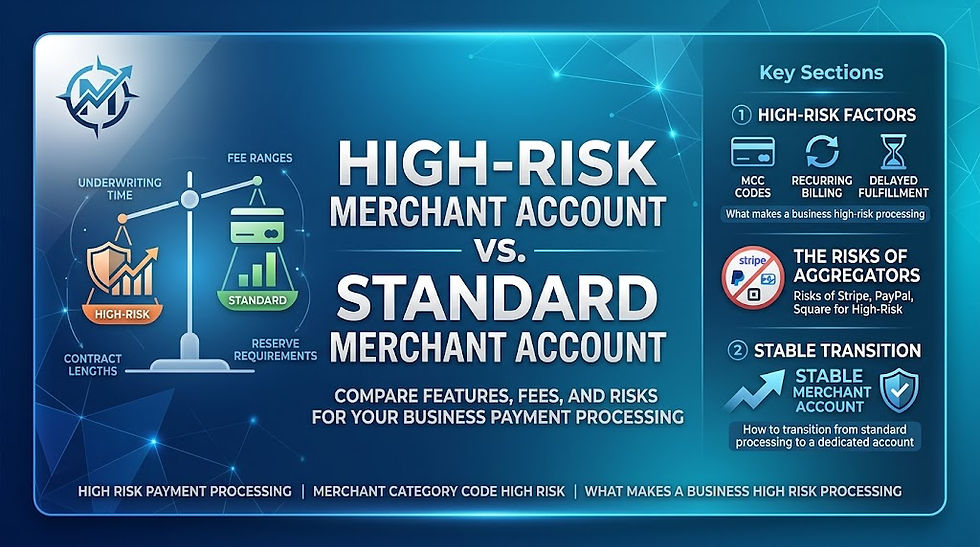
Understanding the structural differences in high risk merchant account vs standard processing is essential to protecting your revenue stream. Whether you are launching an e-commerce brand, scaling a subscription platform, or trying to understand why acquiring banks have flagged your business profile, this guide breaks down underwriting mechanics, pricing structures, regulatory factors, and the path toward true payment stability.
What Is a High-Risk Merchant Account?
A high-risk merchant account is a specialized commercial payment processing account established through acquiring banks and processors equipped to handle businesses with an elevated financial, operational, or reputational risk profile.
When a customer pays by credit card, the acquiring bank front-loads the financial liability of that transaction. If a customer files a chargeback or demands a refund that the merchant cannot pay, the acquiring bank is legally on the hook to repay the cardholder's issuing bank. Consequently, when an enterprise operates in a sector with historically volatile sales, elevated refund disputes, complex regulatory requirements, or long delivery windows, standard banks view that enterprise as a significant credit liability.
High-risk merchant accounts use customized underwriting files, strict security integrations, and strategic cash-reserve structures to mitigate that exposure, allowing higher-risk companies to process large transaction volumes safely without constant threat of sudden termination.
What Is a Standard Merchant Account?
A standard merchant account (often referred to as a low-risk account) is designed for traditional, low-volatility businesses with straightforward fulfillment models and low dispute rates.
Examples include local retail boutiques, standard coffee shops, dry cleaners, accounting firms, and basic business-to-business (B2B) supply companies. Because these companies experience negligible fraud rates, small-to-moderate ticket sizes, and immediate point-of-sale product delivery, financial institutions underwrite them rapidly with minimal upfront scrutiny. In exchange, standard businesses benefit from lower processing markups, faster settlement schedules, and standard month-to-month contracts without reserve obligations.
High-Risk Merchant Account vs. Standard: Direct Comparison
The operational and financial gaps between standard and high-risk merchant processing affect your bottom line, cash flow, and technical setup.
Processing Feature | Standard Merchant Account | High-Risk Merchant Account |
Primary Underwriting Speed | Instant to 48 hours | 3 to 14 business days |
Average Effective Markup | 1.5% – 2.9% + $0.10–$0.30 | 2.5% – 4.95% + $0.25–$0.50 |
Typical Pricing Model | Interchange-plus or low flat rate | Interchange-plus or tiered high-risk |
Account Type | Shared aggregator or dedicated MID | Dedicated Merchant Identification Number (MID) |
Contract Duration | Month-to-month; no cancellation fee | 1 to 3 years with auto-renewal / early termination clauses |
Reserve Requirements | Almost never required (0%) | 5% – 10% rolling reserve, capped reserve, or up-front reserve |
Chargeback Threshold | Strict (< 0.9% of total transactions) | Elevated tolerance (1.5% – 2.0% with active remediation tools) |
Payout & Settlement Speed | Next-day or 48-hour batch deposits | 2 to 5 business days (weekly batches common) |
Geographic Flexibility | Domestic transactions primarily | Multi-currency, cross-border, and offshore capabilities |
Monthly Volume Caps | Generally unrestricted for standard business | Fixed monthly processing ceilings set during underwriting |
What Makes a Business High-Risk for Payment Processing?
Many merchants assume that a "high-risk" classification implies suspicious or illicit activity. In the payments industry, this is a misconception. A business can run an ethical, highly lucrative, and legally compliant operation and still be designated as high-risk by financial underwriters due to systemic liability indicators.
Underwriters look at specific variables when assessing your risk level:
                      ┌────────────────────────────────────────┐
                      │    Underwriting Risk Evaluation        │
                      └──────────────────┬─────────────────────┘
                                         │
     ┌───────────────────┬───────────────┴───────────────┬───────────────────┐
     ▼                   ▼                               ▼                   ▼
┌──────────────┐  ┌──────────────┐                ┌──────────────┐    ┌──────────────┐
│ Industry MCC │  │  Ticket Size │                │ Fulfillment  │    │ Recurring &  │
│  Assignment  │  │  & Volatility│                │     Lag      │    │ Subscription │
└──────────────┘  └──────────────┘                └──────────────┘    └──────────────┘
1. Merchant Category Code (MCC) Designations
Card networks (Visa, Mastercard, American Express, Discover) categorize every merchant using a 4-digit numeric code known as a Merchant Category Code (MCC). Certain industry verticals carry systemic historical loss rates that automatically trigger high-risk processing status across all acquiring networks.
Common high-risk MCC sectors include:
Travel Agencies, Tour Operators, & Airlines (MCC 4722, 3000-3350): Prone to cancellations, geopolitical disruptions, and expensive refund disputes.
Nutraceuticals, Peptides, & Online Supplements (MCC 5122, 5968): Subject to FDA oversight, continuity billing disputes, and card-brand compliance rules.
Vape, E-Cigarettes, & Tobacco (MCC 5993): Heavily regulated with age-verification mandates and regional shipping restrictions.
Firearms & Ammunition (MCC 5723): Subject to state and federal legal friction, background checks, and stringent bank scrutiny.
Online Gaming, Gambling, & Skill Competitions (MCC 7995, 7801, 7994): Heightened rates of friendly fraud and buyer regret chargebacks.
Subscription Boxes & Direct Continuity Marketing (MCC 5968): Prone to consumer disputes over recurring monthly renewals.
Credit Repair, Debt Consolidation, & Financial Seminars (MCC 7299, 7399): Scrutinized for intangible service delivery and variable customer outcomes.
2. Average Ticket Size and Sales Spikes
If your business sells high-ticket merchandise ($500 to $10,000+ per order) such as luxury jewelry, bespoke furniture, industrial machinery, or enterprise coaching a single dispute creates substantial financial exposure. If a merchant processes five $4,000 transactions and defaults after all five are disputed simultaneously, the processor faces a $20,000 loss. Processors categorize high-ticket models as high-risk to protect their capital reserves.
3. Delayed Fulfillment and Pre-Order Cycles
There is a direct correlation between the length of time between payment and fulfillment, and the rate of cardholder disputes. When a customer pays today for a product delivered 45 to 90 days later (such as custom manufactured goods, seasonal event tickets, or Kickstarter-style pre-orders), the window for buyer remorse, customer service breakdowns, and bank chargebacks widens significantly.
4. Subscription and Recurring Billing Models
Cardholders often forget about recurring software-as-a-service (SaaS) charges, monthly wellness boxes, or digital memberships. Rather than contacting the merchant's support team for cancellation, modern banking apps make it easy for consumers to click "Dispute Charge," treating a cancellation request as a fraud claim. This behavior artificially inflates the merchant's chargeback-to-transaction ratio.
5. Credit History and Business Longevity
Acquiring banks act as unsecured lenders. When evaluating a new business, underwriters examine the primary business owner's personal credit score, processing track record, and corporate bank statements. A brand-new business without historical processing data or an owner with poor personal credit will typically require high-risk underwriting terms to secure processing approval.
The Hidden Risks of Flat-Rate Aggregators for High-Risk Businesses
Many emerging businesses default to well-known Payment Service Providers (PSPs) and payment aggregators such as Stripe, PayPal, Square, or Shopify Payments. On the surface, aggregators are appealing: they offer simple interfaces, unified flat-rate pricing, and instant automated approvals.
Omega Bank Card Services
However, for businesses operating anywhere near high-risk territory, using a standard payment aggregator carries major operational hazards.
┌─────────────────────────────────────────────────────────────────────────┐
│                      The Aggregator Shutdown Cycle                       │
└────────────────────────────────────┬────────────────────────────────────┘
                                     │
    1. Instant Auto-Approval (Zero upfront underwriting)
                                     │
                                     ▼
    2. Revenue Scaling (Processing surges beyond baseline)
                                     │
                                     ▼
    3. Retroactive Algorithm Flag (MCC mismatch, dispute blip, volume spike)
                                     │
                                     ▼
    4. Account Freeze & Funds Held (120 - 180 Days)
                                     │
                                     ▼
    5. Risk of MATCH/TMF Blacklist (Severely limits future approvals)
1. Instant Approvals Mean Delayed Underwriting
Aggregators do not underwrite your merchant account when you sign up. Instead, automated algorithms grant you instant access to a large, aggregate Master Merchant Account alongside millions of other users.
Aggregators only perform manual underwriting retroactively typically triggered after your processing volume surges, you process an unusually large transaction, or you experience your first few chargebacks. When human risk analysts finally review your website, MCC code, and product lines, they may classify your business as a violation of their Restricted Business Policy.
2. Sudden Account Terminations and 180-Day Fund Freezes
When an aggregator determines that your business model falls outside its low-risk underwriting parameters, termination is swift and automated. You receive a generic notification stating your account has been closed for "elevated risk."
Because aggregators bear the ultimate financial liability for your customer disputes, they will routinely place a 120-day to 180-day hold on your active funds to cover any potential trailing chargebacks. For a rapidly growing company, losing your daily cash flow and having tens of thousands of dollars locked up can instantly cripple payroll, ad spend, and supplier fulfillment.
3. The Threat of the MATCH List (TMF)
The most severe danger of relying on standard aggregators for high-risk products is the Member Alert to Control High-Risk Merchants (MATCH) list, also known as the Terminated Merchant File (TMF).
If an account is terminated due to excessive chargebacks, suspected fraud, or operating an unapproved business model, the processor can place the business entity and its principals on the MATCH list. Once listed on MATCH, it becomes exceedingly difficult to secure payment processing approval with any domestic or international bank for up to five years.
Understanding High-Risk Processing Costs and Reserve Structures
Because acquiring banks assume greater financial exposure when underwriting high-risk merchants, they introduce specific risk-mitigation pricing and collateral structures.
┌─────────────────────────────────────────────────────────────────────────┐
│                 High-Risk Reserve Account Mechanics                     │
└────────────────────────────────────┬────────────────────────────────────┘
                                     │
         ┌───────────────────────────┴───────────────────────────┐
         ▼                                                       ▼
┌──────────────────────────────────┐   ┌──────────────────────────────────┐
│         Rolling Reserve          │   │          Capped Reserve          │
│ • Processor holds 5% to 10%      │   │ • Processor holds fixed %        │
│   of daily gross sales           │   │   until total target is reached  │
│ • Released on a rolling schedule │   │ • Example: 10% held until        │
│   (e.g., Day 1 released on       │   │   1/2 month volume ($50k) is met │
│   Day 181)                       │   │ • Held throughout contract term  │
└──────────────────────────────────┘   └──────────────────────────────────┘
Fee Components Explained
Higher Discount Rates: Where standard businesses might pay Interchange + 0.30%, high-risk merchants often see markups of Interchange + 1.00% to Interchange + 2.50%, or flat tiered rates ranging from 2.95% to 4.95%.
Per-Transaction Surcharges: Standard gateway transaction fees typically run $0.05 to $0.15. High-risk transaction fees typically range from $0.20 to $0.50 to cover secondary fraud filters and specialized gateway routing.
Chargeback Fees: Standard chargeback fees average $15 to $25 per incident. For high-risk accounts, processors charge between $25 and $45 per formal dispute.
Monthly Gateway & Compliance Fees: High-risk accounts frequently incorporate specialized merchant gateway software (like NMI or Authorize.Net configured with load-balancing) and chargeback defense integrations (such as Verifi CDRN, Ethoca, or Visa Order Insight), carrying monthly SaaS fees between $25 and $99.
Common Reserve Structures
Acquiring banks use reserve accounts as an escrow fund to insulate against runaway disputes:
Rolling Reserve: The processor holds back a small percentage (typically 5% to 10%) of your gross daily sales for a fixed period (usually 180 days). On day 181, the funds withheld on day 1 are released to your bank account, creating a rolling payout cycle.
Capped (Accrued) Reserve: The processor withholds a percentage of daily processing until a specific dollar figure is reached (e.g., equivalent to one month's average processing volume or a flat $50,000). Once that cap is reached, 100% of your daily sales are deposited normally, and the reserve is held until account closure.
Up-Front Reserve: The merchant deposits a lump sum of cash directly into an escrow holding account with the acquiring bank before processing begins. This is common for high-volume enterprise brands with complex compliance profiles.
How to Transition to a Dedicated High-Risk Merchant Account
Transitioning away from unstable payment setups to a dedicated high-risk merchant account requires methodical preparation. By completing comprehensive underwriting upfront, you secure an independent Merchant Identification Number (MID) tied to a sponsor bank that understands and approves your specific business model.
┌────────────────────────────────────────────────────────────────────────┐
│                   Dedicated MID Onboarding Roadmap                     │
└───────────────────────────────────┬────────────────────────────────────┘
                                    │
    1. Compliance & Document Preparation (Bank statements, ID, processing history)
                                    │
    2. Website & Legal Audit (Terms, refunds, privacy, checkout disclosures)
                                    │
    3. Acquirer Matching & Submission (Partner with vertical-specific sponsor banks)
                                    │
    4. Gateway Setup & Load Balancing (Integrate NMI/AuthNet, dispute webhooks)
                                    │
    5. Gradual Volume Migration (Ramp processing over 14-30 days to avoid shock)
Step 1: Assemble Your Underwriting Dossier
Acquiring bank risk committees look for financial transparency and operational legitimacy. Prepare a comprehensive underwriting packet containing:
Government-issued photo identification for all owners with 25%+ equity.
Articles of Incorporation, operating agreements, and business licenses.
A voided business check or signed bank reference letter for fund disbursements.
3 to 6 months of corporate business bank statements showing operating capital.
3 to 6 months of continuous merchant processing statements (including chargeback and refund ratios).
Supplier/fulfillment agreements proving production capacity and inventory logistics.
Step 2: Optimize Your Website for Underwriting Compliance
Underwriters perform a thorough review of your digital storefront or landing page before issuing a decision. Your website must clearly display:
Terms of Service and Privacy Policy: Prominently linked in the footer and during the checkout flow.
Explicit Refund and Cancellation Policies: Plain language explaining how customers can return items or cancel recurring subscriptions.
Customer Support Contact Details: An active customer service phone number, support email, and physical business address clearly visible on your site.
Checkout Disclosures: Checkboxes requiring users to agree to recurring billing terms, delivery timeframes, and terms of service before entering payment details.
SSL Encryption and Security Badges: Active HTTPS encryption across your entire domain and payment checkout portal.
Step 3: Integrate Redundant Merchant Accounts (Load Balancing)
As your monthly volume passes $50,000 to $100,000, relying on a single merchant account introduces a single point of failure. High-risk e-commerce enterprises frequently use payment gateways that feature automated load-balancing (such as NMI).
Load-balancing allows you to connect multiple dedicated MIDs from different acquiring banks into a single checkout system. Your gateway routes transactions dynamically across accounts based on:
Monthly processing caps per bank.
Transaction amounts and card types.
Risk-scoring rules.
Chargeback mitigation targets across individual MIDs.
If one processing bank encounters technical downtime or adjusts its volume capacity, your payment gateway automatically shifts volume to your alternate accounts without interrupting your live customer transactions.
Frequently Asked Questions
Can a high-risk business ever be reclassified as a standard merchant?
In certain cases, yes. If your high-risk status was driven primarily by a short operating history, personal credit issues, or a temporary surge in chargeback rates, you can request a re-underwriting evaluation after establishing 12 to 24 months of clean, stable processing history with low dispute ratios. However, if your business is classified as high-risk due to its core Merchant Category Code (MCC) such as online gaming, nutraceuticals, firearms, or adult entertainment the high-risk status remains permanent due to card-brand compliance rules.
What is the acceptable chargeback threshold for payment processors?
Visa and Mastercard enforce formal dispute monitoring programs. For standard accounts, acquiring banks generally require merchants to keep their chargeback-to-transaction ratio below 0.9% (fewer than 90 chargebacks per 10,000 transactions). Dedicated high-risk processors provide greater flexibility, accommodating ratios between 1.0% and 1.5%, especially when the merchant uses automated dispute-prevention tools such as Ethoca or Verifi alerts.
What happens if my payment processing account is frozen?
If your account is frozen by a payment aggregator or acquiring bank, immediately request the specific reason in writing and assemble documentation demonstrating fulfilled orders, customer delivery confirmations, and proof of inventory. Do not attempt to open a duplicate account under an alternate email on the same aggregator platform, as this triggers automated fraud systems and increases the risk of being placed on the MATCH/TMF blacklist. Instead, begin working with an experienced high-risk merchant services provider to secure a stable, dedicated merchant account.
Secure Your Business With a Stable High-Risk Payment Solution
Operating a high-risk business with a standard payment processor is an avoidable risk to your company's revenue and long-term viability. A sudden account suspension, fund hold, or processor termination can stall your growth and halt operations overnight.
Moving to a dedicated high-risk merchant account provides transparent terms, realistic dispute limits, and customized underwriting backed by banks that understand your industry.
Stripe
Stop risking unexpected account freezes and lost revenue.
[Get Approved for a Dedicated High-Risk Merchant Account Today] — Speak with our processing specialists to receive a comprehensive statement review, transparent interchange-plus pricing, and custom payment gateway integration tailored to your specific business model.


Comments